Purchase Order Receiving Software: Six Checks Before You Buy
Evaluate receiving software with a partial delivery, case-pack conversion, supplier change, and invoice difference. Includes an interactive fictional checklist.
Purchase order receiving software should tell your team what arrived, what was accepted, and what remains unresolved. A completed delivery checklist is useful only if the buyer and bookkeeper can connect it to the purchase they agreed to make.
This buying guide is for retailers, kitchens, and stockrooms where someone orders and someone else checks deliveries. Use it to evaluate the handoff with one representative order. For the step-by-step operating procedure, see the supplier receiving process.
Start with the exception, not the perfect delivery
A demonstration that receives every ordered item in full misses the decisions that create work. Bring a partial delivery, a changed pack size, or an invoice that differs from the agreed purchase.
Use this fictional example: a shop orders six cases of shampoo, with four gallon bottles per case. Four cases arrive first. The other two are still due. The receiver should be able to explain both the delivery and the open balance without editing a separate spreadsheet.
The purchasing workflow
Buy in cases. Receive in sellable units.
Read before ordering
A dense operator briefing for teams that need sharper buying, cleaner supplier follow-up, and fewer expensive surprises.
↳ Update the mapped item and location for the actual receipt, with one system responsible for posting it.
Fictional example: one supplier case contains four gallon bottles. These are illustrative quantities, not customer data.
The arithmetic is simple. Keeping those quantities consistent across the PO, receipt, stock location, and next buying review is the evaluation.
Six checks to run in a receiving-software demo
1. Can the receiver identify the correct item and unit?
Check the supplier SKU, purchase pack, item description, and destination. Ask the demonstrator to receive four cases when the stock record uses bottles. Then ask what happens if the supplier changes the pack from four to six bottles.
The useful answer includes a mapping and a review step. Typing the number four into a field labeled “units” is not enough to show that sixteen bottles entered the correct stock record.
2. Can a partial receipt leave a clear balance?
After the first receipt, ask the system to show ordered, received, and outstanding quantities together. Have a different team member find the balance without help from the person who created the PO.
Then test the next event. The supplier might deliver the remainder, cancel it, or propose a replacement. Those outcomes need distinct records. A canceled balance should not continue to look like stock that is coming tomorrow.
3. Can the team distinguish a supplier proposal from an approved change?
A confirmation might increase the price, substitute an item, or move the date. Ask who reviews that change, where the original agreement remains visible, and which version the receiving team uses.
4. Can staff record a problem where they check the goods?
Test the actual device and process: a phone on the floor, a shared computer, or a printed checklist returned to the office. Record a damaged item or wrong SKU and check where the buyer finds that note.
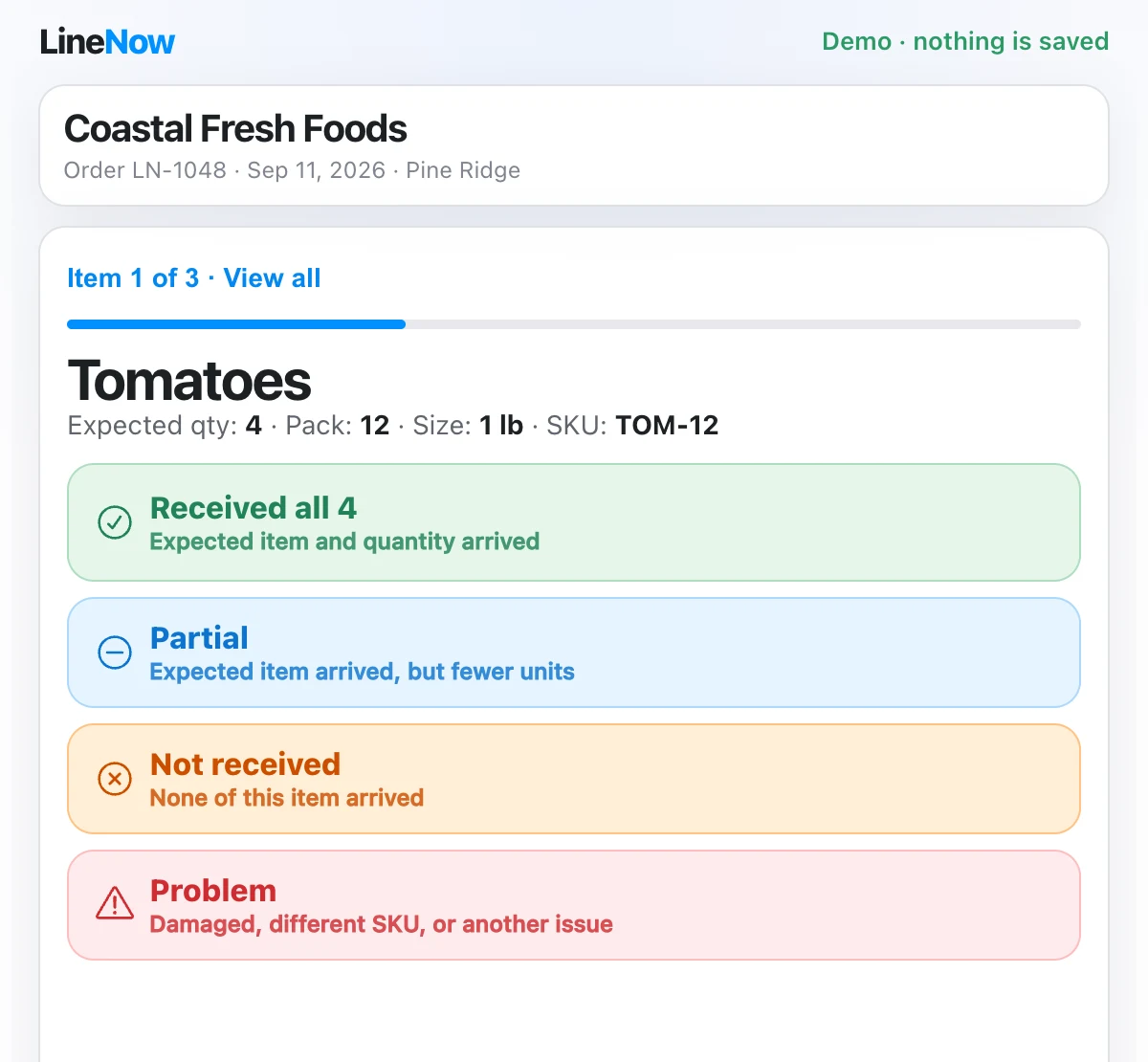
Existing LineNow demo screenshot using fictional data. The public receiving demo saves nothing and does not exercise live supplier messages, inventory writes, or accounting integrations.
A software record supports your receiving process. Temperature checks, quarantine decisions, expiry controls, and supplier claim procedures must still follow your operation’s requirements.
5. Which system changes the inventory?
Write down the item mapping, receiving location, and system responsible for posting the receipt. Then check the external stock result if a POS or inventory integration is part of your purchase.
Receiving the same delivery independently in both applications can double-count stock. A read-only connection cannot promise the same result as a configured stock-write integration. Ask the vendor to demonstrate the exact platform and direction you need.
6. What does the bookkeeper receive?
Show the invoice alongside accepted quantities, approved prices, and relevant delivery charges. Ask finance to explain a difference using the record, without asking the buyer to search their inbox.
A recorded receipt does not approve an invoice or prove that every accounting field synchronizes. Define mappings, review responsibilities, and the supported bill handoff. See the QuickBooks purchasing workflow.
Native POS tools, receiving apps, and warehouse systems
Before adding software, check the tools you already use. Shopify supports purchase orders and receiving through linked inventory transfers. Square offers purchase orders and partial receiving on supported plans. Those features may be sufficient for a straightforward workflow. Shopify documentation, Square documentation.
A broader purchasing system is worth evaluating when supplier changes, pack mapping, outstanding quantities, and bill context repeatedly fall between teams. A warehouse management system may be necessary when bins, picking, shipping, scanner hardware, or advanced routing drive the project. Clarify which job you are buying for before comparing feature lists.
Agree on a small acceptance checklist
Test
Evidence to inspect
Six cases ordered, four received
Sixteen bottles accepted and eight still due
Supplier proposes a change
Original request, proposed change, and buyer decision remain distinguishable
Receiver records damage
Item-level problem visible to the buyer
Second delivery or cancellation
Remaining balance changes for the correct reason
Connected stock update
One receipt posts to the mapped item and location once
Invoice differs from receipt
Finance can explain the difference before approval
Ask your own receiver to repeat the task. Setup effort, clear units, and a usable exception process matter as much as a polished demonstration.