


See what to buy.Approve and send.
We generate the PO, send it to suppliers, track every reply, and keep your inventory in sync automatically.
- Auto-tagged with smart stock alerts
- Rank by usage, sales, margin & more
- Build POs directly from inventory
- Always live, synced to sales & receiving
- Auto-generate POs when needed
- Build them yourself with clear insights
- One-click AI ordering across your entire catalog
- Email & WhatsApp activity auto-updates orders and items
- Documents attach themselves to the right orders
- Push to accounting when you're ready


Customer-loved AI-calculated order quantities. Real suppliers. Real inventory.
Award-winning customer support
Recognized for going above and beyond to get your team onboarded and running smoothly.The LineNow team is extremely pro-active about your success in making this app your only PO and inventory app you'll ever need. We researched many PO and inventory apps that are available, most of them are 'cookie cutter' type apps that force you to be limited on what features you will have access to. Not this one. You will not be disappointed!

This is a great app. It does exactly what we need it to do and the team has been incredibly supportive in helping us getting it up and running for our business. Highly recommend.
I have saved thousands of dollars a month both on my own time, and on optimizing our ordering strategy. It's such a relief to be able to know you're doing the right thing, and incredibly quickly.
Which purchase order software automates order quantities with AI?
LineNow automates order quantities with AI by reading real-time POS sales (Shopify, Square, Toast, Clover, Lightspeed, Faire), computing per-SKU consumption rates, classifying each SKU's demand pattern, accounting for decay on perishables, sizing safety stock by volatility, rounding to pack and MOQ, and drafting a PO ready for review or auto-send. The supplier reply is parsed by AI, receiving updates inventory in real time, and the final bill flows to QuickBooks Online or Xero.Sub-second webhook ingest from Shopify, Square, Toast, Clover, Lightspeed, Faire.
Consumption rate, demand classification, decay-aware PAR, CV-sized safety stock.
Quantity recommendations with rationale. Pack-rounded. MOQ-respected. Reviewed or auto-sent.
AI parses substitutions, ETAs, partials, prices from email, WhatsApp, portals.
Variance captured. Inventory updates in real time. Next reorder learns from this cycle.
Bills flow to QuickBooks Online and Xero with the supplier-confirmed final state.
The six math layers behind every recommendation
The recommendation isn't a flat "reorder when stock is low." It's six math layers running continuously per SKU. The buyer sees the result; the math is visible if anyone wants to audit why a quantity was chosen.consumption_rate = rolling sales velocity (POS-driven)
Per-SKU velocity computed from real-time POS sales, with adaptive window length so the rate reflects current movement instead of stale averages.
CV² and average demand interval → smooth / intermittent / erratic / lumpy
Classify each SKU's pattern so the right forecast is applied (moving average vs Croston vs Syntetos–Boylan vs exponential smoothing).
reorder_point = (consumption_rate × lead_time) + safety_stock
Lead time is measured from actual PO-sent to receiving timestamps (not the supplier's claim). Safety stock floats with volatility.
safety_stock = z_score × σ_demand × √lead_time
CV-aware sizing keeps service level constant across the catalog without dead capital on low-volatility SKUs.
PAR = base_demand × (1 + decay-aware uplift) + safety_stock
Decay rate adjusts the PAR upward so perishables don't stock out — and don't over-stock and waste.
order_quantity = CEIL((PAR − on_hand − inbound) / pack_size) × pack_size
Round to pack size and respect supplier MOQ. Inbound (open POs) reduces new-order quantity to avoid double-ordering.
Which industries benefit from AI order quantities?
AI-driven order quantities pay off most when SKU count exceeds human memory, demand patterns are mixed, or the supplier mix forces variance the operator can't mentally model. Six operating shapes where the math materially changes outcomes.Recipes are first-class. Sales of finished dishes decrement ingredients through yields. Decay-aware PAR handles perishables.
Toast records 80 sandwich sales this week → ingredient consumption rates update for turkey, bread, lettuce, mayo → PO drafts to the produce vendor for next week with decay-aware quantities.
POS-driven velocity per SKU. CV-aware classification distinguishes everyday best-sellers from intermittent specialty items.
Square sales feed into demand classification → fast-mover gets a tight safety stock; specialty single-origin gets bigger safety buffer → POs to wholesale vendors rounded to case pack.
Customer order is the trigger. SKU maps to supplier(s). PO drafts and sends per supplier with customer ship-to.
Shopify customer order arrives → routing rules split items by supplier → POs auto-send via supplier's preferred channel (EDI, email, portal) → tracking flows back to Shopify.
BOMs replace recipes. Finished-goods sales decrement components. Lead times per component drive multi-supplier orchestration.
Shopify or Faire orders for a finished SKU → BOM explosion to components → POs to component suppliers staggered by lead time so production never stalls.
Per-location PARs, central warehouse acts as internal supplier. Branch orders consolidate into supplier POs.
Each branch's POS sells through inventory → branch orders to central warehouse trigger consolidated supplier PO → receiving at warehouse triggers transfers to branches.
POS-driven order quantities plus compliance: vendor license expiry, COA capture per lot, FEFO picking, audit-ready history.
Lightspeed cannabis POS feeds demand → POs include vendor license check → receiving captures COA and manifest → FEFO picking applied to inventory state.
POS systems supported natively
Real-time webhook integrations across the POS systems SMBs actually use. Other POS systems integrate via CSV upload, manual entry, or custom API.Procurement that
runs itself
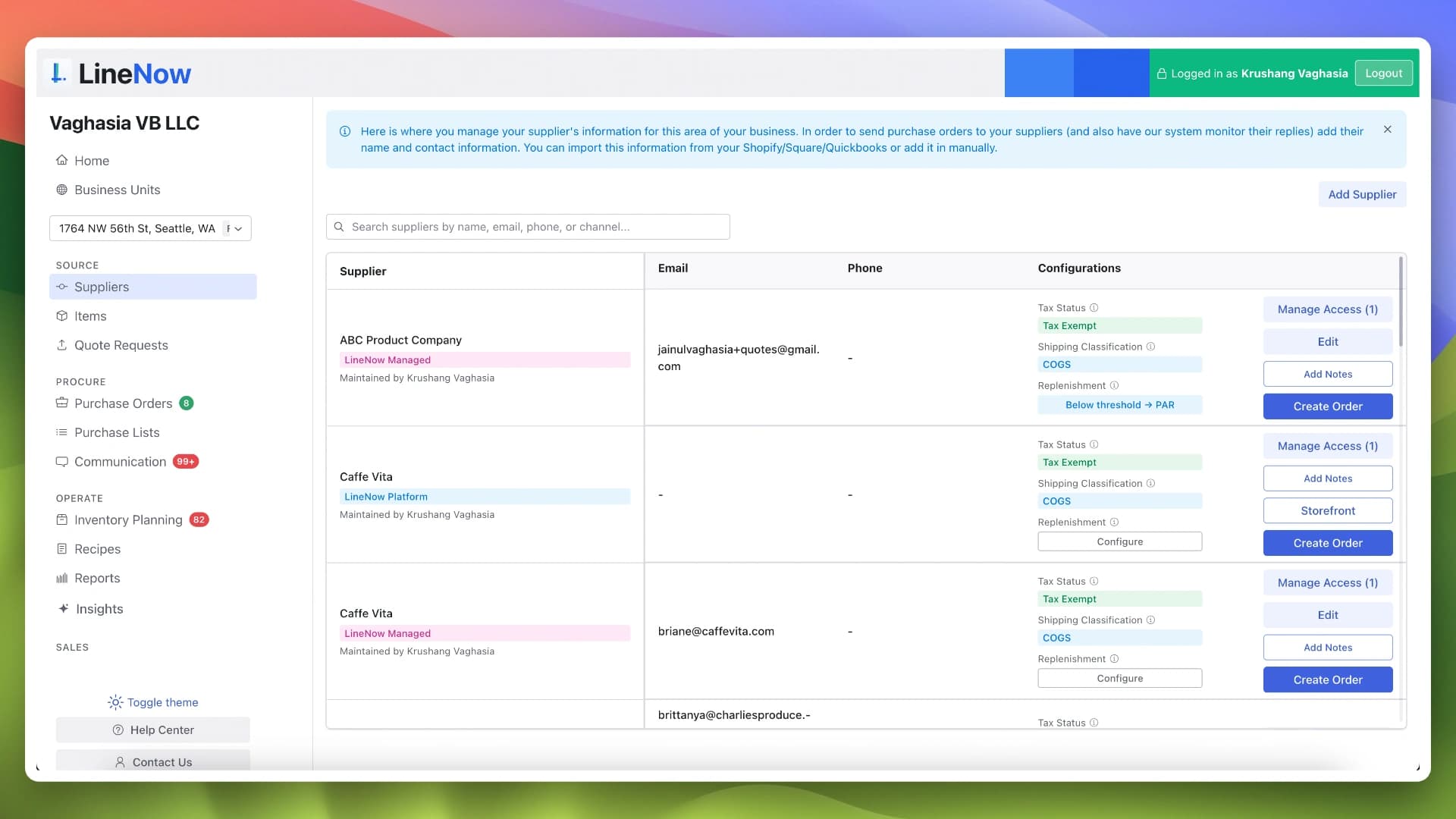
Three steps. Every supplier. Zero chaos.Bring every supplier into one place
Connect all your suppliers: storefronts, emails, WhatsApp, phone orders. One standardized workflow replaces the chaos of managing dozens of different supplier processes.- Add any supplier in under a minute
- Works with email, WhatsApp, and web storefronts
- Standardized catalog across every supplier
Your operations assistant.
Talk to your business. Ask what to order, build a cart across every supplier, and send everything in one click.LineNow vs other AI procurement options
Honest comparison of the five categories of AI-powered replenishment software. The right fit depends on which part of the loop is the bottleneck.Keep more of what you earn.
See your savings in real time.
Time and errors are more expensive than they appear. Tell us how you operate — we'll show you what LineNow saves, every month.
Ours: $50/mo — 90-day free trial included.
Built for your type of business.
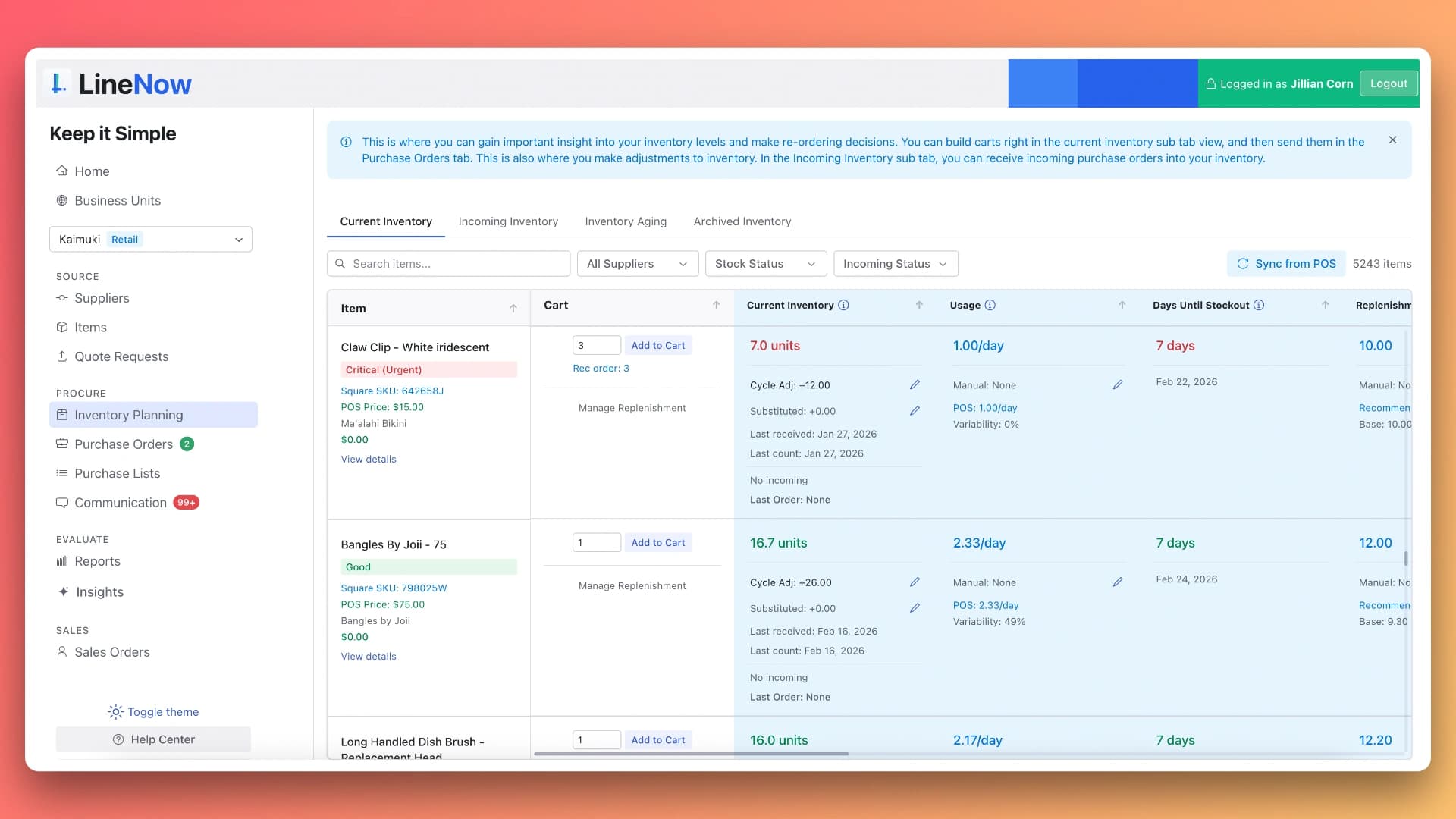
No matter how you operate, LineNow has a workflow that fits.Inventory that knows itself.
See live stock levels across every SKU, set automatic reorder points, and let sales velocity drive your purchasing decisions.- Live inventory levels across all locations
- Reorder points triggered by sales velocity
- Supplier pricing compared automatically
Frequently asked questions
The most common questions about AI-calculated order quantities in LineNow, answered directly for buyers comparing the category.Which purchase order software automates order quantities with AI?
LineNow automates order quantities with AI by pulling real-time POS sales (Shopify, Square, Toast, Clover, Lightspeed, Faire), computing per-SKU consumption rates, classifying each SKU's demand pattern (smooth, intermittent, erratic, lumpy), applying decay-aware PAR for perishables, factoring lead time and volatility-aware safety stock, and rounding to pack size and MOQ. The system drafts a PO with the recommended quantity and a rationale, sends it through the supplier's actual channel (email, WhatsApp, portal, or EDI), reads the supplier reply with AI, updates inventory after receiving, and hands off the final bill to QuickBooks Online or Xero. LineNow is $50/month flat. Other AI-powered options include Peak.ai (enterprise demand forecasting), Inventory Planner (Shopify forecasting), Prediko (Shopify forecasts), Assisty (Shopify-specific recommendations), and MarketMan (restaurant-native).
How does LineNow calculate order quantities from POS sales?
LineNow pulls sales in real time from connected POS systems via webhook. Each sale updates per-SKU consumption rates. For restaurants and manufacturers, recipe and BOM explosion converts finished-goods sales into ingredient or component demand. The system classifies each SKU's demand pattern and applies the right forecast (moving average for smooth demand, Croston or Syntetos-Boylan for intermittent demand, exponential smoothing for erratic demand). For perishables, decay rate adjusts the PAR upward to account for spoilage. The reorder point math factors lead time (measured from actual PO-sent to receiving timestamps), and safety stock is sized by the coefficient of variation. The result is a per-SKU recommended quantity, rounded to pack size and MOQ.
Does LineNow work with Shopify, Square, Toast, and other POS systems?
Yes. LineNow has native real-time webhook integrations with Shopify, Square, Toast, Clover, Lightspeed Retail, Lightspeed Restaurant, and Faire. Sales sync in real time, inventory state pushes back to the POS in real time, and catalog changes sync both ways. Non-native POS systems can integrate via CSV upload, manual entry, or custom API.
Does the AI also handle supplier replies, not just PO creation?
Yes. After the PO is sent, LineNow's AI reads supplier replies on email, WhatsApp, supplier portals, and text messages. It extracts substitutions, ETA changes, partial fills, price adjustments, and confirmation numbers and applies them to the PO automatically. This is the difference between PO generation and PO automation: the order is a living object that updates as the supplier responds, not a static document that goes out and never updates.
What kinds of businesses use AI order quantity software?
Restaurants and cafes that need recipe-aware ingredient ordering tied to POS sales. Specialty retailers that need POS-driven replenishment without manual stock-walks. Multi-location retailers replenishing branches from a central warehouse. Dropshippers routing customer orders to suppliers. Small manufacturers ordering components based on BOM demand. Regulated retailers (cannabis, CBD, pharma-adjacent) that need POS-driven ordering plus compliance tracking. The common shape is 50+ SKUs, 5+ suppliers, real POS sales as the demand signal.
How is this different from Inventory Planner, Prediko, or Stocky?
Inventory Planner is Shopify and NetSuite-focused with strong forecasting math but supplier comms is email-only and supplier reply parsing is not built in. Prediko is Shopify-focused with forecasts but doesn't close the supplier comms loop. Stocky is Shopify-only and being discontinued in 2026. LineNow covers POS sources beyond Shopify (Toast, Square, Clover, Lightspeed, Faire), runs recipe and BOM math (which is required for restaurants and manufacturers), reads supplier replies with AI across email/WhatsApp/portal, and pushes final-state bills to QuickBooks and Xero. The trade-off: Inventory Planner has the deepest forecast math for pure Shopify operations; LineNow has the widest closed-loop coverage for SMBs with mixed POS and supplier channels.
Can I trust the AI recommendations? What's the human review step?
For most teams, the default is "system drafts, buyer reviews, buyer sends" — the human stays in the loop. The buyer sees the recommended quantity, the rationale (consumption rate, days of cover, pack-size rounding, recent supplier reliability), and any inbound POs that should be consolidated. After 4+ weeks of validation, trusted suppliers can move to scheduled auto-send. Dropshipping orders auto-route in real time because the trigger is a real customer order, not a forecast.
Keep going on AI order quantities, POS sync, and closed loop
Deep-dives on the math behind the recommendations, the supplier reply layer that absorbs reality after the PO is sent, and the comparisons that map LineNow against the AI procurement alternatives.Low-Stock Alerts and Automatic Purchase Orders in LineNow
How revenue-at-risk-ranked alerts pair with three auto-PO modes — recommendation, scheduled, dropship — to close the loop from POS sale to bill.
Read guide →GuideReduce Stockouts Using Automated Inventory Software
Seven mechanisms that actually reduce stockouts — and why alert-only tools shift work later in the cycle without preventing the stockout.
Read guide →Buyer GuideInventory Software That Syncs POS Sales and Auto-Creates Purchase Orders
Ranking the nine platforms that actually close the POS-to-PO loop end to end — and the ones that look like they should but don't.
Read guide →GuideHow AI Reads Your Supplier Emails
The supplier reply layer — substitutions, ETAs, partials, prices — extracted by AI from email, WhatsApp, and PDF confirmations.
Read guide →GlossaryPAR Level — Full Math
Decay-aware PAR formula for perishables, with worked examples and the relationship to consumption rate and lead time.
Read guide →GlossarySyntetos–Boylan Approximation
Bias-corrected intermittent-demand forecasting — the right method for SKUs that sell in clumps with quiet periods.
Read guide →ComparisonLineNow vs Inventory Planner
Forecasting depth vs closed-loop execution. When Inventory Planner fits — and when LineNow's wider channel coverage matters more.
Read guide →ComparisonLineNow vs Prediko
Shopify forecasting vs supplier execution. The trade-off between forecast precision and the rest of the procurement loop.
Read guide →Works with your tools
Plug into the tools you already use. No rip and replace.